

GOOSE vs Sampled Values: Understanding IEC 61850 Messaging
On a recent digital substation project in the north of England, our team watched two perfectly valid IEC 61850 designs diverge in cost and complexity. One used GOOSE messaging for protection trips and interlocking, keeping conventional current transformers and wiring them into merging units. The other went further and streamed Sampled Values from non-conventional instrument transformers across the process bus. The GOOSE-only option was commissioned faster and cost less; the Sampled Values design gave the utility richer data and a future-proof architecture. Neither was wrong — the choice came down to understanding exactly what each protocol does and where it fits. That is the decision we want to unpack here.
What Is IEC 61850 Messaging and Why It Matters
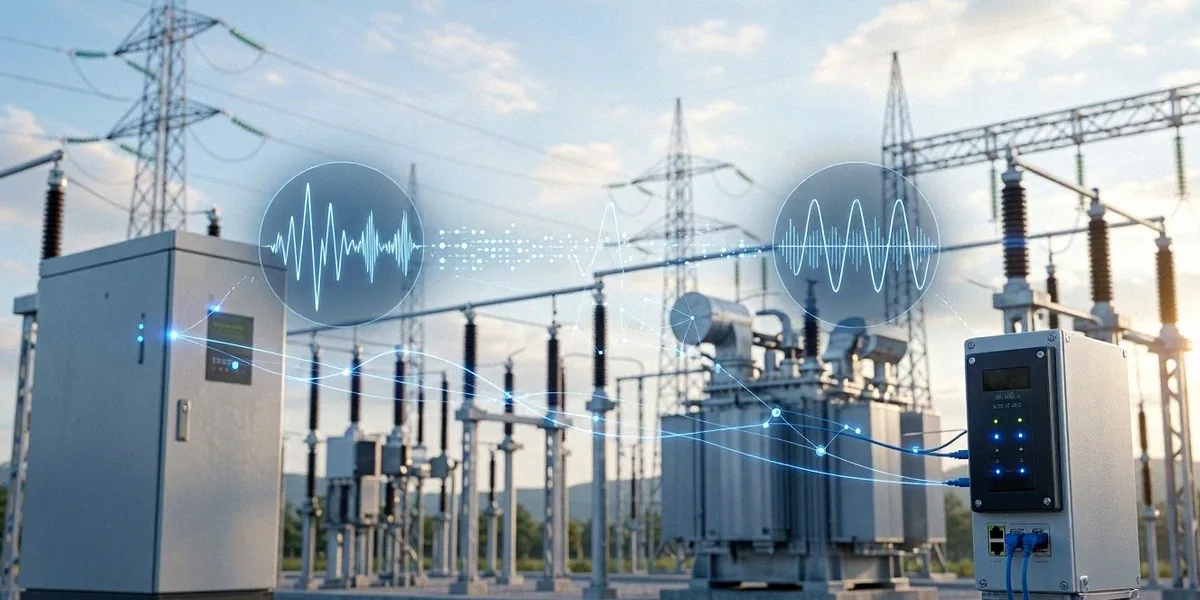
IEC 61850 is the international standard that governs communication, data modelling and configuration in substation automation. It replaced a patchwork of vendor-specific protocols with a single, object-oriented framework, and it is now the backbone of digital substation rollouts across Europe. In the UK, National Grid has driven adoption through its digital substation programme, while distribution network operators have followed with their own pilots. Within the standard, two protocols do most of the heavy lifting on the process and station bus: GOOSE (Generic Object Oriented Substation Event) and Sampled Values (SV).
The Shift from Hardwired to Digital Signals
Traditional substations rely on copper wiring: trip circuits, interlock wiring, and analogue current and voltage signals travelling point to point between bays. Every signal needs a core, a terminal block and a commissioning test. Digital substations replace that copper with Ethernet frames. GOOSE carries status, trip and interlock information; Sampled Values carry digitised current and voltage waveforms. The result is less wiring, faster installation, and the ability to interrogate signals in software rather than with a multimeter.
How IEC 61850 Fits Into Smart Grid Architecture
IEC 61850 sits at the substation layer of the wider smart grid, connecting protection relays, bay controllers, merging units and the SCADA gateway. Above it, protocols such as DNP3 or IEC 60870-5-104 carry data to control centres, while MQTT and REST interfaces increasingly feed analytics platforms. Because IEC 61850 models data semantically — a circuit breaker position is a named object, not a raw point — it integrates cleanly with smart grid functions like adaptive protection, condition monitoring and wide-area awareness.
GOOSE Messaging: The Event-Driven Workhorse
GOOSE is a peer-to-peer, publisher-subscriber protocol designed for fast, reliable delivery of status changes. A relay publishes a GOOSE message when something changes — a trip command, a breaker position, an interlock condition — and any subscriber on the network acts on it. There is no polling and no client-server handshake, which is precisely why it is so fast. Manufacturers including Siemens and ABB have supported GOOSE across their relay ranges for well over a decade, and it is now standard practice in UK 400 kV substations for protection signalling between bays.
How GOOSE Achieves Sub-3ms Latency
GOOSE messages are mapped directly to Layer 2 Ethernet, bypassing the IP stack entirely. Publishers repeat messages continuously with a short retransmission interval that backs off when nothing changes, so subscribers always hold a fresh value. Combined with prioritised VLAN tagging under IEEE 802.1Q, this delivers typical transfer times below 3 ms and often under 1 ms on a well-designed network — comfortably inside the 4 ms Class P3 requirement for the most demanding protection schemes.
Typical Applications in UK Protection Schemes
In UK practice, we see GOOSE used for:
- Inter-trip and transfer trip signals between protection relays across a substation
- Busbar protection and breaker failure initiation
- Interlocking schemes for disconnectors and earth switches
- Backup protection signalling where hardwired pilots are being retired
- Fast load shedding and demand-side response commands
Sampled Values: Streaming Raw Data at Speed
Sampled Values is a multicast protocol that continuously publishes digitised current and voltage samples from a merging unit onto the process bus. Under IEC 61850-9-2, the standard sample rate is 80 samples per cycle for protection (4,000 samples per second at 50 Hz) and 256 samples per cycle for power quality. Unlike GOOSE, SV never stops — it is a constant stream, and every subscriber receives the same waveform data. UK pilot projects run by ScottishPower and National Grid Electricity Transmission have demonstrated SV-based process buses on both transmission and distribution networks.
The Role of Merging Units and Non-Conventional Instrument Transformers
A merging unit digitises analogue outputs from conventional current and voltage transformers, or receives digital output directly from non-conventional instrument transformers such as Rogowski coils and optical voltage sensors. It time-stamps each sample and publishes it as an SV stream. Removing conventional iron-cored CTs eliminates saturation problems and reduces the physical footprint of a bay, which matters enormously on constrained urban substation sites.
Bandwidth and Synchronisation Requirements
SV is bandwidth-hungry. A single 80 samples-per-cycle stream for one protection core can consume several megabits per second, and a full bay with multiple cores multiplies that quickly. This drives the case for gigabit process bus networks and careful VLAN design. Synchronisation is equally critical: every merging unit must align to a common time source, typically IEEE 1588 Precision Time Protocol, so that samples from different units can be compared correctly in differential protection algorithms.
Key Differences: GOOSE vs Sampled Values
The cleanest way to think about it is this: GOOSE is event-driven, Sampled Values is continuous. GOOSE tells you something happened; SV tells you exactly what the waveform looked like when it happened. Both can — and frequently do — coexist on the same IEC 61850 network, sharing switches and VLAN infrastructure.
Latency and Determinism
GOOSE targets sub-3 ms transfer for trip signals. SV latency is less about transfer time and more about sample alignment; the requirement is deterministic delivery within a defined time window, usually under 3 ms, so that relays can reconstruct an accurate picture of the power system at a precise instant.
Data Volume and Network Impact
GOOSE traffic is bursty and light in normal operation, spiking during fault conditions. SV traffic is constant and heavy, consuming a predictable slice of bandwidth at all times. A process bus carrying SV needs capacity planning from day one; a station bus carrying GOOSE is far more forgiving.
When to Use Each Protocol
- Use GOOSE when you need fast status, trip or interlock signalling between intelligent electronic devices.
- Use Sampled Values when you need raw waveform data at the relay, typically with merging units and NCITs.
- Use both when building a full digital substation with a process bus and a station bus.
Practical Considerations for UK Digital Substations
Deploying IEC 61850 messaging in the UK means working within National Grid’s digital substation roadmap, the Energy Networks Association’s engineering recommendations, and the commercial reality of regulated price controls. Upcoming projects such as the Eastern Green Link, which will move power between Scotland and England, depend on robust digital communication architectures to manage long-distance flows and offshore connections.
Cyber Security and IEC 62351
IEC 62351 is the security companion to IEC 61850. It defines authentication, encryption and role-based access for GOOSE, SV and MMS traffic. In practice, we see UK utilities applying IEC 62351 alongside network segmentation, IEC 62443 zone-and-conduit design, and strict change control on substation switches. Ignoring it is no longer an option — Ofgem and the NCSC both expect demonstrable cyber resilience in new build and retrofit projects.
Testing and Commissioning Best Practices
Commissioning a digital substation is a different discipline from testing copper. Our teams rely on:
- SCD file validation and vendor interoperability checks before site delivery
- Network capture and analysis of GOOSE and SV traffic during FAT
- Time synchronisation verification across all merging units and relays
- End-to-end protection testing with injected SV streams and simulated GOOSE trips
- Cyber security acceptance testing aligned to IEC 62351 requirements
The Future of IEC 61850 Messaging in Europe
European utilities are pushing IEC 61850 messaging into new territory. Edge computing nodes at the substation can now process GOOSE and SV data locally for analytics, anomaly detection and adaptive protection, sending only summaries upstream. 5G slices are being trialled as backup paths for teleprotection, and virtualised protection functions are moving from dedicated hardware onto containerised platforms.
Convergence with IoT and Cloud Platforms
While GOOSE and SV remain firmly on-premises for latency and security reasons, their outputs increasingly feed IoT gateways and cloud analytics. Substation data models are being mapped to MQTT topics and time-series databases, allowing asset managers to correlate protection events with condition monitoring and maintenance records.
Standard Evolution and Interoperability
IEC 61850 continues to evolve through Edition 2.1 and work on digital twin interfaces. Interoperability remains the hardest practical problem, and UK utilities are pressing vendors to demonstrate multi-vendor GOOSE and SV operation before acceptance. As net-zero targets drive more renewables and more distributed generation onto the network, that interoperability becomes a national infrastructure concern, not just an engineering preference.
Mastering both GOOSE and Sampled Values is now a core competency for UK engineers building resilient, future-proof digital substations. GOOSE gives you speed and simplicity for event signalling; Sampled Values gives you fidelity and flexibility for waveform-level protection. Understanding when to deploy each — and how to make them work together under IEC 62351 — is what separates a successful digital substation project from an expensive experiment.
FAQ
Can GOOSE and Sampled Values run on the same network?
Yes. Both are Layer 2 Ethernet protocols and can share the same physical infrastructure using separate VLANs. In practice, most digital substations keep SV on a dedicated process bus and GOOSE on the station bus, but converged designs do exist where bandwidth and latency budgets allow.
What sample rate does IEC 61850 Sampled Values use?
The standard protection rate is 80 samples per cycle, which equals 4,000 samples per second on a 50 Hz system. Power quality applications often use 256 samples per cycle, generating significantly higher bandwidth demand.
Is GOOSE secure enough for UK transmission substations?
GOOSE itself has no inherent security, which is why IEC 62351 adds authentication and encryption. Combined with network segmentation and strict access control, this meets the expectations of National Grid and UK regulators for new digital substation deployments.
Do I need merging units to use Sampled Values?
Yes, in almost every case. A merging unit digitises analogue outputs from conventional instrument transformers or receives digital data from non-conventional instrument transformers, then publishes the SV stream onto the process bus.
Which protocol should a UK distribution network operator prioritise first?
Most DNOs start with GOOSE because it delivers immediate benefits — reduced wiring, faster protection signalling and easier interlocking — with lower bandwidth and synchronisation demands. Sampled Values typically follows once process bus skills and testing procedures are established.