Winter Peak Demand and the Role of Digital Substations in the UK Grid
It is 5pm on a dark January evening. Somewhere in the Midlands, a heat pump kicks in, a kettle goes on, and an electric vehicle starts charging off-peak. Multiply that by millions of homes and you have the winter peak — the single most stressful hour of the year for the UK transmission network. The question we keep coming back to is simple: is the grid genuinely ready for it? Our answer, after years of working on substation automation projects across Europe, is that the copper-and-relay infrastructure of the 1970s is being asked to do a 2020s job. Digital substations, built around IEC 61850, are how we close that gap.
Why Winter Peaks Still Test the UK Grid
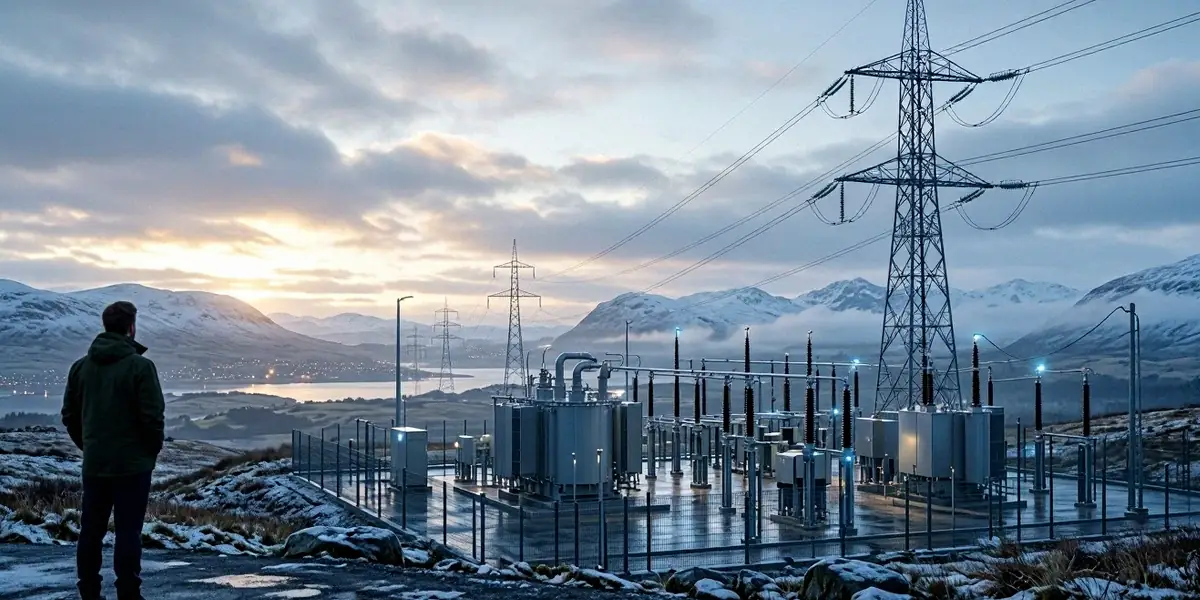
Winter peaks are not new. What is new is the shape of them. National Grid ESO’s Winter Outlook has, for several years now, flagged tighter margins during cold, still, dark evenings when wind output can drop just as demand spikes. The traditional safety net has been the Capacity Market, which pays generators and demand-side providers to be available when the system is stretched. It works — but it was designed for a world of large thermal plants, not millions of distributed heat pumps and chargers.
The 4-7pm Winter Window
The critical window runs roughly from 4pm to 7pm on winter weekdays. Solar has faded, commercial demand is still high, and domestic demand climbs sharply as people get home. National Grid ESO’s Winter Outlook typically identifies this as the period of lowest de-rated margin. It is also when the largest single-hour ramp of the day occurs, often several gigawatts within 60 minutes.
Electrification Is Changing the Shape of Demand
Electrified heating and EV charging are not just adding megawatts — they are changing the curve. Heat pumps run hardest when it is coldest, which correlates with peak demand. Smart charging helps, but not every charger is smart yet, and not every household responds to price signals. The result is a peak that is higher, steeper, and less predictable than the one the network was planned around.
What the Capacity Market Can and Cannot Fix
The Capacity Market can procure generation and demand-side response. What it cannot do is fix constraints inside the distribution network, or make a legacy substation relay faster. If a fault occurs at 5:30pm on a cold Tuesday, the speed of protection and the accuracy of fault location are matters of physics and engineering, not market design.
What a Digital Substation Actually Does
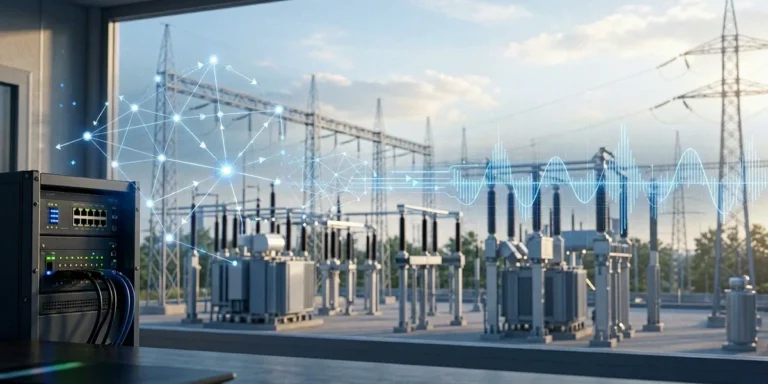
Strip away the marketing and a digital substation is fairly straightforward. Instead of running thousands of copper cables from switchyard equipment to protection relays, you install merging units in the yard, digitise the measurements at source, and send them over fibre using IEC 61850. That is the whole idea. The standard is the glue that makes it work across vendors and voltage levels.
From Copper Wiring to Fibre and Process Bus
A traditional 400kV substation can contain hundreds of kilometres of copper wiring. It is expensive, hard to test, and prone to CT saturation and earth loop issues. The process bus replaces much of that with a small number of fibre links carrying Sampled Values and GOOSE traffic.
Merging Units and Sampled Values Explained
A merging unit sits next to the current and voltage transformers, samples the analogue signals, and publishes them as IEC 61850-9-2 Sampled Values. Relays subscribe to those streams instead of being hard-wired. The practical benefits we see on site are:
- Fewer copper terminations, so less to get wrong during commissioning
- Digital measurements that can be shared by multiple functions, including protection, metering and power quality
- Easier extension of bays without re-pulling cables across the yard
- Better diagnostics, because every stream is timestamped and logged
Why This Matters More in Winter
Under winter peak conditions, equipment runs closer to its limits. Transformer temperatures rise, tap changers work harder, and the consequences of a misoperation are larger. Digital substations give operators better visibility and faster, more selective protection — which is exactly what you want when the margin is thin.
GOOSE Messaging: The Fast Lane for Protection
GOOSE — Generic Object Oriented Substation Event — is defined in IEC 61850-8-1. It is peer-to-peer Ethernet communication used for time-critical signals such as trips, interlocks, and breaker fail initiation. It bypasses the client-server MMS stack entirely and publishes directly onto the station or process bus, typically achieving transfer times in the low single-digit milliseconds.
How GOOSE Differs from MMS and SV
MMS is the client-server protocol used for configuration, reporting and control. It is flexible but not fast enough for protection. SV carries raw sampled measurements. GOOSE carries state changes and commands. In a modern bay, you will often see all three on the same physical network, separated logically by VLANs.
Real-World Tripping Times and Redundancy
In well-designed systems we routinely see end-to-end trip times under 10ms, including publisher, network and subscriber processing. Redundancy is normally handled with parallel redundant networks (PRP) or high-availability seamless redundancy (HSR), so a single fibre break does not take out protection.
Where UK Projects Are Using It
GOOSE is now standard in UK transmission substations. National Grid’s digital substation programme has deployed it across multiple sites, and it is a core part of the protection philosophy on new 400kV and 275kV bays. It is also increasingly common at 132kV on distribution networks.
UK Projects Putting IEC 61850 to Work
This is not theoretical. Several UK networks have been running IEC 61850-based digital substations for years, and the pace is accelerating.
National Grid and the Great Grid Upgrade
National Grid’s Great Grid Upgrade is the largest overhaul of the transmission network in decades. Digital substation design is central to it, with IEC 61850 process bus and GOOSE used to reduce construction time and physical footprint at new and upgraded sites.
SP Energy Networks in Central and Southern Scotland
SP Energy Networks has run a series of digital substation projects in Scotland, including trials that demonstrated process bus and non-conventional instrument transformers in live 132kV and 275kV environments. These projects have informed their standard designs and helped build internal IEC 61850 expertise.
SSEN and the North of Scotland
SSEN’s north of Scotland network upgrades are driven by the huge volume of onshore and offshore wind connecting in the region. Sites such as Deeside and Kintore have featured digital substation technology as part of wider reinforcement works, helping to manage the long distances and constrained corridors that characterise the north of Scotland.
The Engineering Challenges We Still See
We are not going to pretend this is all smooth. Three issues come up on almost every project.
Interoperability Between Vendors
IEC 61850 is a standard, not a guarantee. SCL files from different vendors still need careful engineering, and edge cases in GOOSE and SV implementation occasionally bite during FAT and SAT. The Energy Networks Association has done useful work here, but the reality is that interoperability requires testing, not trust.
Cyber Security and NIS Regulations
The NIS Regulations put real obligations on operators of essential services. Digital substations increase the attack surface: Ethernet networks, remote engineering access, and software-defined functions all need defending. IEC 62351 helps, but it is not a complete answer, and we see wide variation in how rigorously it is applied.
The Skills Gap in Substation Automation
Good IEC 61850 engineers are scarce. The skill set spans protection, networking, and configuration tooling — a combination that traditional training routes do not produce. We see this directly in recruitment and in the length of commissioning programmes.
What This Means for Winter 2025 and Beyond
The direction of travel is clear. More digital substations, more flexibility markets, and tighter coordination between transmission and distribution operators.
Flexibility Markets and Demand Side Response
Flexibility markets allow households, businesses and industrial users to shift demand away from the 4-7pm window. Digital substations provide the granular measurement and control needed to verify and settle those services.
Transmission and Distribution Coordination
As distributed generation and storage grow, the boundary between transmission and distribution matters less. Digital substations with IEC 61850 interfaces make it practical for DNOs and NESO to share data and coordinate actions in real time.
The Path to 2030
The UK’s 2030 clean power target requires a grid that can absorb far more variable renewable generation while keeping the lights on through winter peaks. Digital substations, IEC 61850, GOOSE and smart grid technology are not optional extras in that plan — they are the foundation.
Digital substations are not a silver bullet. They will not build a gigawatt of storage or calm a storm. But they are a necessary foundation for keeping the lights on during increasingly electrified UK winters, and the projects already delivered in Scotland and across the transmission network show the approach works.
FAQ
What is a digital substation in simple terms?
It is a substation where analogue measurements are digitised close to the primary equipment and shared over fibre using IEC 61850, replacing most of the copper wiring between the switchyard and the protection and control room.
Is GOOSE messaging safe for protection trips?
Yes, when designed correctly. IEC 61850-8-1 GOOSE is used for protection tripping in UK transmission substations, with redundancy provided by PRP or HSR and rigorous factory and site testing before energisation.
Which UK networks are furthest ahead with IEC 61850?
National Grid’s digital substation programme is the largest, while SP Energy Networks and SSEN have delivered significant projects in Scotland, including sites such as Deeside and Kintore in the north.
Does the Capacity Market solve winter peak demand on its own?
No. It procures generation and demand-side capacity, but it cannot address network constraints, protection performance, or the local impacts of electrified heating and EV charging.
How does this relate to the UK’s 2030 clean power target?
Meeting the 2030 target means integrating far more renewable generation and flexible demand. Digital substations and IEC 61850 provide the measurement, control and protection foundation that integration depends on.