Sampled Values and the Process Bus: The Backbone of Digital Substations
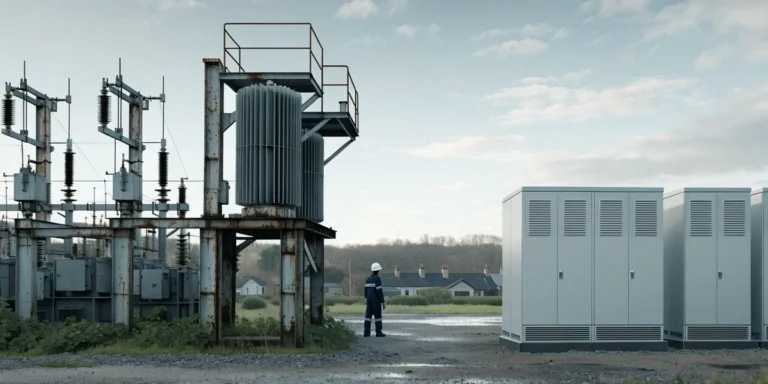
Walk into a UK primary substation built in the 1980s and you will still see it: hundreds of metres of copper multicore cable, every current transformer and voltage transformer hard-wired back to a relay panel. Now picture a modern digital substation in the same footprint, where a single fibre-optic cable carries digitised current and voltage measurements from the switchyard to every protection and control device in the building. That shift is happening across the UK right now, and at the centre of it sits a protocol most engineers outside the protection world have never had to think about: Sampled Values. If you work on substation automation, smart grid projects, or digital substation rollouts, Sampled Values and the process bus are no longer a niche curiosity — they are becoming the default design choice.
What Are Sampled Values and Why Should You Care?
Sampled Values (SV) are defined in IEC 61850-9-2 and carry digitised voltage and current measurements from merging units to protection and control devices over Ethernet. Instead of a copper pair per measurement, you get a multicast stream of sampled data points — typically 80 samples per cycle for protection-class applications — published onto the substation LAN. The practical effect is dramatic: a bay that once needed dozens of analogue cables now needs one fibre connection. That means less copper, smaller cable trenches, fewer terminations, and lower installation and maintenance costs across the whole digital substation.
For UK network operators under pressure to deliver more capacity with fewer outages, this matters. Fewer wired connections means fewer failure points, faster commissioning, and the ability to reconfigure protection schemes in software rather than with a screwdriver.
The Difference Between Sampled Values and GOOSE
People often lump SV and GOOSE together because both ride on IEC 61850 Ethernet networks, but they do very different jobs. Sampled Values carry continuous measurement data — the raw digitised currents and voltages. GOOSE (Generic Object Oriented Substation Events) carries event-driven status and trip signals, such as a circuit breaker position or an intertrip command. SV is a steady, high-bandwidth stream; GOOSE is bursty and latency-critical. Both are essential to the process bus, but confusing them leads to bad network design, especially when you are sizing switches and planning VLANs.
How Merging Units Fit Into the Picture
The merging unit (MU) is the device that makes Sampled Values possible. It sits close to the primary equipment, receives analogue outputs from conventional CTs and VTs (or digital outputs from non-conventional instrument transformers), samples them synchronously, and publishes the resulting SV stream onto the process bus. In many UK installations the MU is integrated into the bay controller or protection relay itself, while in others it is a standalone unit mounted in the switchyard. Either way, the MU is where the analogue world ends and the digital substation begins.
The Process Bus: Architecture and Real-World Benefits
The process bus is the communication network that carries SV and GOOSE traffic between primary equipment and bay-level devices. In a typical architecture, merging units publish SV onto the process bus, protection relays subscribe to those streams, and GOOSE messages travel in both directions for tripping and status. Most UK and European projects base their SV implementation on IEC 61850-9-2LE, a widely adopted implementation guideline that fixes sample rates and message formats so that equipment from different vendors can interoperate.
The benefits we see most often cited by UK project teams include:
- Reduced wiring — one fibre replaces hundreds of copper cores, cutting installation time and cost.
- Easier testing — you can inject SV streams from a test set without physically accessing CT circuits.
- Improved safety — fewer live CT connections to work around during commissioning and maintenance.
- Greater flexibility — protection and control functions can be reassigned in software as the network evolves.
Point-to-Point vs. Shared Process Bus Topologies
There are two main ways to build a process bus. In a point-to-point topology, each merging unit connects directly to a single protection device — simple, deterministic, and easy to reason about, but it does not scale well and offers limited sharing. In a shared process bus, multiple MUs and multiple relays communicate over a common switched network, often with redundant paths. Shared topologies are where the real benefits of IEC 61850 emerge, but they demand careful network engineering, VLAN segregation, and rigorous testing before energisation.
Redundancy and Network Design Considerations
Because protection now depends on Ethernet, network resilience is non-negotiable. UK projects typically use IEC 62439-3 Parallel Redundancy Protocol (PRP) or High-availability Seamless Redundancy (HSR) so that a single cable or switch failure does not interrupt SV or GOOSE traffic. Switch selection, port mirroring for diagnostics, and clear documentation of the SV/GOOSE data flow all matter far more than they did in a hard-wired scheme. Get the network design wrong and you will not find out until the first fault — which is exactly when you cannot afford it.
UK Adoption: Where Are We Now?
The UK has moved well beyond PowerPoint pilots. National Grid has operated digital substations using IEC 61850 process bus technology in projects such as the Deeside Centre for Innovation, using it as a live testbed for new protection and control architectures. On the distribution side, SSEN’s £12 million Project LEO in Oxfordshire used smart grid technologies including IEC 61850 to support flexibility markets and real-time network visibility. These are not lab demonstrations — they are energised assets feeding real customers.
The Energy Networks Association (ENA) has published guidance on IEC 61850 implementation for UK DNOs, giving distribution engineers a common reference for how SV, GOOSE, and the process bus should be deployed. And Ofgem’s Network Innovation Allowance (NIA) has funded several UK digital substation trials involving process bus, which has helped move the technology from transmission-led innovation into mainstream distribution planning.
Key UK Pilot Projects and Lessons Learned
Across the pilots we have followed, a few themes keep coming up. First, early engagement with vendors on interoperability saves months later. Second, commissioning teams need training on SV capture and analysis tools long before the first energisation. Third, the operational staff who will live with the substation must be involved in design reviews — a process bus that only the project team understands is a liability, not an asset.
Regulatory and Standards Landscape in the UK
The UK operates within the European IEC 61850 ecosystem, which means IEC 61850-9-2LE remains the de facto baseline for Sampled Values. Edition 2 and the newer Edition 2.1 of the standard add clarifications around engineering, redundancy, and network management. Alongside this, the ENA’s engineering recommendations and Ofgem’s innovation funding framework shape how DNOs justify and document digital substation investment. For anyone specifying a UK project today, aligning with these documents is not optional — it is how you get sign-off.
Challenges and Practical Considerations for Engineers
We would be doing you a disservice if we pretended the process bus was plug-and-play. It is not. The challenges are real, and they are the reason some UK projects have taken longer than planned.
Interoperability and Vendor Lock-In
IEC 61850 is a standard, but implementation choices still vary between ABB, Siemens, GE, and others. SV streams that look identical on paper can behave differently in the lab, particularly around configuration file handling and time-stamping. Our advice is to insist on interoperability testing with at least two vendors before committing to a single-supplier design, and to keep the SCL (Substation Configuration Language) files under strict change control. Vendor lock-in is a commercial risk as much as a technical one.
Time Synchronisation and Network Load
Sampled Values only work if every merging unit samples at the same instant. That means IEEE 1588 Precision Time Protocol (PTP) is effectively mandatory, with GPS-backed grandmasters and careful attention to switch latency. Get PTP wrong and differential protection will misoperate. Network load is the other trap: SV streams are bandwidth-hungry, and adding GOOSE, MMS, and engineering traffic onto the same infrastructure without proper VLAN planning will eventually cause problems.
Cybersecurity for the Process Bus
Once protection depends on Ethernet, cyber risk becomes safety risk. IEC 62351 provides the security framework, but practical deployment in UK substations is still maturing. At minimum, we recommend strict VLAN segregation, disabling unused ports, monitoring for anomalous SV or GOOSE traffic, and treating the process bus as a security zone in its own right rather than an extension of the corporate network.
The Future of Sampled Values in Smart Grids
Sampled Values are not just a wiring replacement — they are the data foundation for everything a smart grid needs to do next. Once voltage and current are available as time-synchronised digital streams, wide-area monitoring, adaptive protection, and faster fault location become far easier to implement. That directly supports the UK’s net-zero transition, where renewable generation, battery storage, and flexible demand all require protection systems that can adapt in real time.
Integration with IEC 61850 and Smart Grid Applications
Because SV sits inside the wider IEC 61850 framework, it integrates naturally with substation-level functions such as interlocking, automation, and SCADA. Looking ahead, we expect SV data to feed analytics platforms that detect incipient faults, support condition-based maintenance, and provide the measurement backbone for flexibility markets. IEC 61850 Edition 2.1 tightens some of the engineering and redundancy details that earlier adopters found ambiguous, which should accelerate adoption further.
What’s Next for UK Digital Substations
Expect more NIA-funded trials, more DNO standardisation on process bus architectures, and more pressure from Ofgem on evidence that digital substations deliver measurable whole-life cost savings. We also expect to see SV used in more distribution-level applications, not just transmission, as non-conventional instrument transformers become cheaper and more familiar to UK designers.
FAQ
What are Sampled Values in IEC 61850?
Sampled Values are digitised voltage and current measurements defined in IEC 61850-9-2. They are published by merging units onto an Ethernet process bus and subscribed to by protection and control devices, replacing traditional copper wiring in digital substations.
What is the difference between Sampled Values and GOOSE?
Sampled Values carry continuous digitised measurements, while GOOSE carries event-driven status and trip signals. Both use IEC 61850 Ethernet networks, but SV is a high-bandwidth stream and GOOSE is latency-critical and bursty.
Is the IEC 61850 process bus used in the UK yet?
Yes. National Grid has operated digital substations using IEC 61850 process bus technology, including work linked to the Deeside Centre for Innovation, and SSEN’s Project LEO in Oxfordshire used IEC 61850 as part of its smart grid platform. Ofgem’s Network Innovation Allowance has also funded several process bus trials.
Why is time synchronisation so important for Sampled Values?
SV streams from different merging units must be sampled at the same instant for protection algorithms such as differential protection to work correctly. IEEE 1588 PTP is normally used to achieve this, and errors in time distribution can cause protection misoperation.
What is IEC 61850-9-2LE?
IEC 61850-9-2LE is an implementation guideline for Sampled Values that fixes sample rates and message formats. It is widely adopted across the UK and Europe to ensure interoperability between merging units and protection relays from different vendors.
Sampled Values and the process bus are not a passing trend — they are the backbone of the digital substation and a practical enabler of the UK’s net-zero transition. The challenges around interoperability, time synchronisation, and cybersecurity are real, but they are solvable with good design, early testing, and the right skills. Our team’s view is simple: engineers who embrace SV and the process bus now will be the ones leading the next decade of UK substation automation, while those who wait will be retrofitting under pressure later.